-
Welcome to the Structural Mechanics Course!
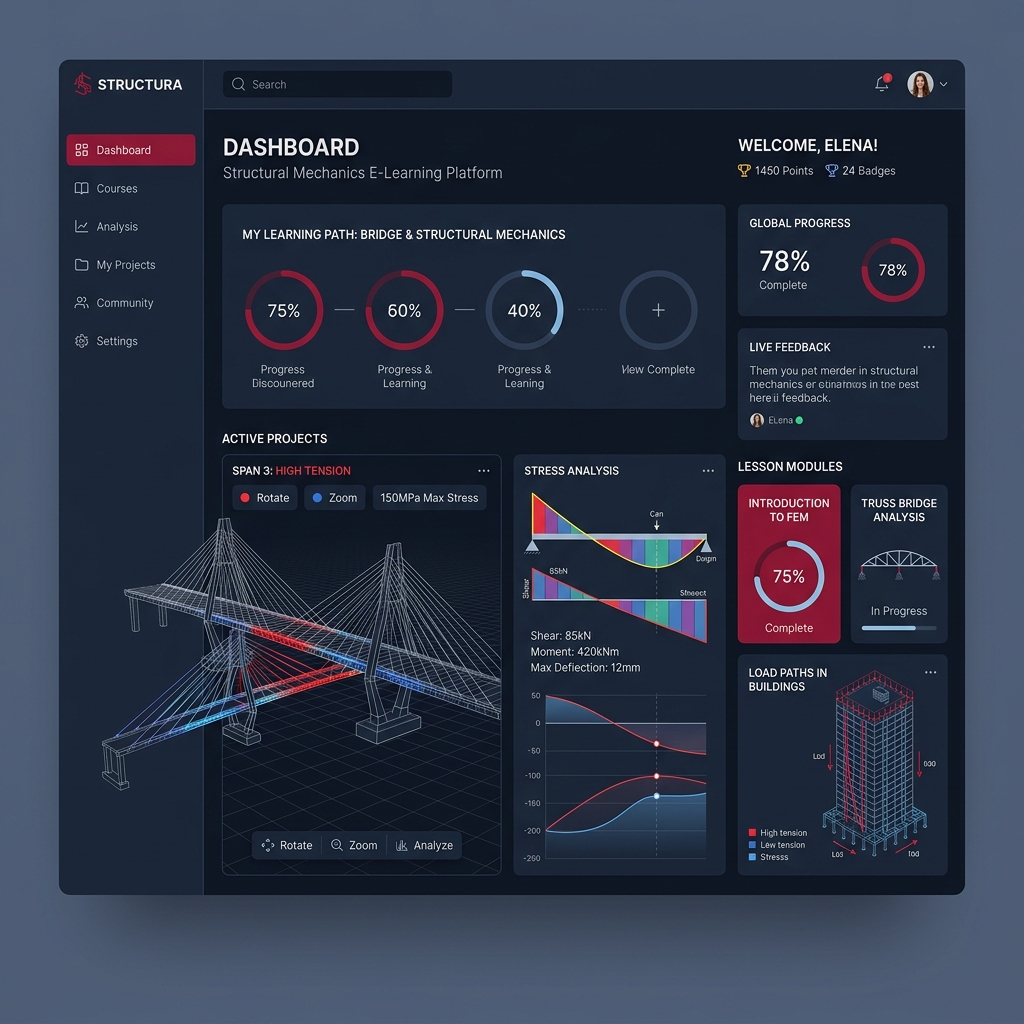
Embark on an exciting journey to unlock the principles of structural mechanics. This course is designed for aspiring designers and analysts in engineering, providing you with the knowledge and skills needed to excel in your field. Through expert instruction, practical examples, and interactive learning, you'll gain a deep understanding of structural mechanics and its real-world applications. Join us to elevate your expertise and confidently tackle complex engineering challenges.
-
Build In-Demand Skills for Designers & Analysts
Career-focused internship for students to prepare and succeed in technical interviews.
Featured Program
Program Accreditation
This program is evaluated by AICTE and implemented under the NEAT Initiative (National Educational Alliance for Technology).

Why this Program?
Demand for fresh engineers who can analyse and solve real-world structural mechanics challenges is skyrocketing in aerospace, automotive, and general mechanical manufacturing alike. Industries today need engineers who can think critically, visualise in 3D, and connect physics to real design and analysis problems.
The Goal of the Program
Program Definition
Module 1 — Structural Physics
If you’ve ever wondered why structures hold, fail, or flex the way they do, this is where you’ll finally find out.
Structural Physics is the heart of design, it helps you see how forces flow, how materials respond, and how every line in a design sketch carries meaning.
This course helps you think like a designer, not just a solver. Through simple explanations, stunning 2D and 3D animations, and real engineering examples, you’ll start connecting physics with product design, the way it happens in the real world.
By the end of this module, you’ll:
- Build strong intuition in structural behavior and design intent.
- Learn how to justify every design decision like a pro.
- Gain interview confidence with 49 OEM-style questions designed to test real understanding.
- Develop the mindset that top recruiters look for: clarity, curiosity, and creativity.
This is where your foundation for design and analysis truly begins, not with formulas, but with understanding.
Module 2 — Assessments with LRS
Forget rote tests. These assessments are real engineering experiences. Every question is built to make you think deeper, visualize better, and reason like a designer solving a real-world challenge.
With over 600 carefully crafted exercises, you’ll test your understanding across every level, from grasping fundamentals to applying them in complex, industry-relevant problems.
What’s inside:
- 250+ Concept Checks to help you master the “why” behind every formula.
- 49 Mock Interview Questions drawn from actual OEM and research lab interviews.
- 210 Benchmarking Challenges that evaluate how you think, visualize, and design.
- 3-Level Holistic Evaluation to measure your growth from knowledge to application.
Each assessment is a small step toward scientific thinking, design clarity, and professional readiness.
By the end, you’ll have built not just accuracy, but engineering instinct, the kind that sets you apart in interviews and internships alike.
Module 3 — Design & Manufacture
Here’s the truth, what most engineers learn in their first 5–10 years on the job, you’ll learn here in just a few hours.
This module bridges the gap between classroom theory and how design actually happens in the industry.
Through simplified explanations and step-by-step visualizations, you’ll explore:
- How great designs are born from physics.
- How materials, methods, and performance come together in real product development.
You’ll also pick up best practices that seasoned engineers swear by, presented in the most accessible, engaging way possible.
This isn’t just knowledge; its industry experience distilled into learning you can see, feel, and apply.
By the end, you won’t just design, you’ll design with purpose.
Module 4 — Python for Design
Engineering is evolving fast. Hand calculations and GUI software alone can’t handle today’s complex, data-driven challenges. That’s where Python becomes your game-changer.
In this course, you’ll learn to connect structural mechanics with code, automating stress checks, visualizing vibration modes, and generating insights that matter. Using NumPy, SciPy, Matplotlib and Sympy, you’ll move from solving problems to engineering them.
Each lesson follows a powerful flow: from real-world problem definition and analytical recap to hands-on coding, result interpretation, and
wrap-up challenges
that make learning stick.By the end, you’ll not only understand shear, bending, vibration.., you’ll code them, visualize them, and explain them confidently in interviews.
This isn’t just a coding course. It’s your bridge to industry readiness, where physics meets automation, and your engineering career truly begins.
- Python basics for engineers
- Matrix formulations & solvers
- Automation & plotting
Module 5 — E-Books for Structural Design
A Comprehensive Reference Guide on Stress & Vibration:
“Fundamentals of Stress & Vibration”
- An extremely detailed e-book with 500 plus illustrations (self-explanatory) to accompany the course. The book has several advanced topics such as
- Dynamic stress computation
- Fatigue Life estimation
- Engineering Material selection
- Corrosion
- Asymmetric bending, non-linear torsion, and more..
- The e-book has 50 gem case-studies which are derived from real time engineering design assignments. These are well ordered to ensure systematic competency building for Designers and Analysts.
Program Intent
The Proficiency in Applied Structural Mechanics program is a comprehensive learning pathway designed to bridge the gap between academic concepts and real-world engineering practice. It caters to a diverse audience—undergraduates, fresh graduates, and practicing engineers—by offering a structured and industry-aligned approach to mastering core principles of structural design and analysis.
As Internship program for Undergraduates


An Induction Program for Fresh Engineering Graduates


As a Faculty Development Program


Our Pedagogy
Our pedagogy follows Bloom’s Taxonomy, ensuring a structured learning journey — from building strong fundamentals to developing analytical thinking and creative problem-solving skills. We focus on helping learners progress from remembering concepts to creating real-world solutions with confidence.

Fundamentals of Stress & Vibration